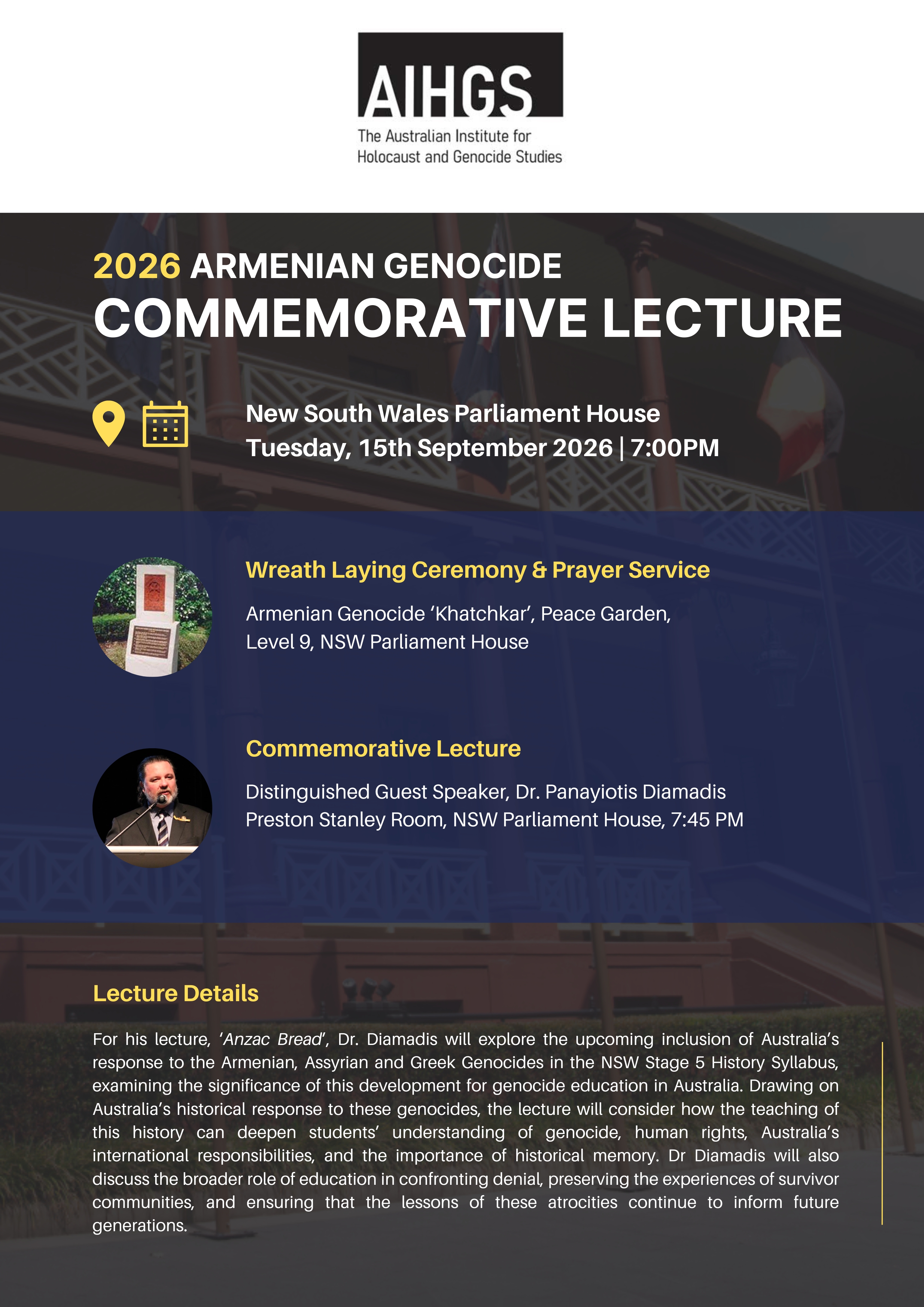
SYDNEY: The Australian Institute for Holocaust and Genocide Studies (AIHGS) is pleased to announce that Dr. Panayiotis Diamadis will be the keynote speaker at the 30th Armenian Genocide Commemorative Lecture, held at the Parliament of New South Wales on Tuesday, 15 September 2026, commencing at 7:00pm.
Since 1996, the Armenian Australian community has sponsored the commemorative lecture to express our gratitude to the NSW parliament for becoming the first legislature in Australia to recognise the 1915-1923 Armenian Genocide.
The event will comprise of a wreath-laying ceremony at the Armenian Genocide Memorial Khatchkar (cross-stone) located in parliament grounds, followed by Dr. Diamadis’ lecture.
Event Details:
Wreath Laying Ceremony & Prayer ServiceStarting Time: 7:00 PM
Date: Tuesday, 15 September 2026
Location: Armenian Genocide Khatchkar, Level 9, Parliament of New South Wales
Commemorative LectureStarting Time: 7:45 PM
Date: Tuesday, 15 September 2026
Location: Jubilee Room, Parliament of New South Wales
The guest speaker for the evening will be Dr Panayiotis Diamadis — an academic, educator and community advocate with extensive experience in genocide studies, history education, public affairs and intercultural relations. Dr Diamadis has dedicated much of his career to advancing awareness and understanding of genocide, human rights and the experiences of communities impacted by mass atrocities.
In 2025.
For his lecture, ‘Anzac Bread’, Dr Diamadis will explore the upcoming inclusion of Australia’s response to the Armenian, Assyrian and Greek Genocides in the NSW Stage 5 History Syllabus, examining the significance of this development for genocide education in Australia. Drawing on Australia’s historical response to these genocides, the lecture will consider how the teaching of this history can deepen students’ understanding of genocide, human rights, Australia’s international responsibilities, and the importance of historical memory. Dr Diamadis will also discuss the broader role of education in confronting denial, preserving the experiences of survivor communities, and ensuring that the lessons of these atrocities continue to inform future generations.